Toward generalizable and interpretable AI in regulatory genomics - Nature
What the report says
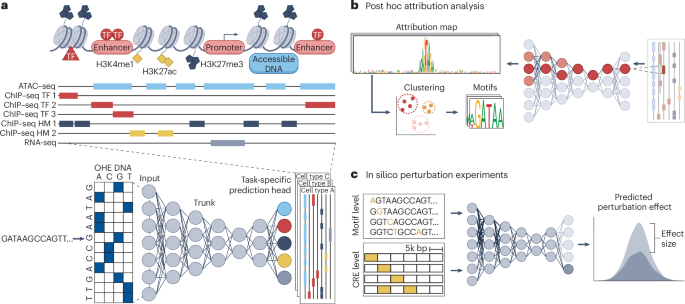
Nature reported in a Review article that artificial intelligence models used in regulatory genomics are advancing rapidly but still face important limits in generalizing beyond the settings in which they are trained. The article focuses on sequence-to-function, or seq2func, models, which aim to predict molecular regulatory readouts directly from DNA sequence. These systems are being used to support variant effect prediction, mechanistic interpretation of gene regulation and the design of regulatory DNA sequences.
According to the Review, strong results on held-out genomic regions do not consistently translate into reliable performance across genetic variation or different cellular contexts. The authors examine how model architecture, training data and prediction tasks can influence model behavior. They also discuss how interpretability tools and evaluation strategies have revealed both features of cis-regulatory organization and recurring failure modes, helping explain why predictive accuracy alone may not produce robust biological understanding.
The Nature article frames this as a central challenge in biology: understanding how DNA sequence encodes gene regulation. It points to a growing body of work in deep learning, functional genomics, regulatory variant prediction and synthetic enhancer design, while noting that current models can fall short when asked to explain mechanisms or perform in new biological contexts.
The Review argues that progress will require treating seq2func models as systems that are repeatedly improved through feedback between AI and experiments. In that approach, targeted perturbation experiments, systematic evaluation and iterative model updates would be linked to refine models over time and make them more useful for biological discovery.
Loading debate for this article…
Other publishers covering this story
No additional verified coverage is currently clustered with this report.
Related reporting
 Mityana Women Urged to Seek Early Breast Cancer AssessmentNile Post
 Mityana Residents Seek More Time to Register for Mosquito NetsNile Post
 Low Awareness Fuelling Late Detection of Autism in ChildrenNile Post
 Patient care at centre of govt’s planned health reforms - Daily MonitorDaily Monitor
Poverty and healthcare barriers expose Kiyindi women to reproductive health risks - PML DailyPML Daily
Patient care at centre of govt’s planned health reforms - Daily MonitorDaily Monitor
Poverty and healthcare barriers expose Kiyindi women to reproductive health risks - PML DailyPML Daily
 Muslim Youth Council to Launch Skilling Initiative to Tackle UnemploymentNile Post