Planetary-mass exosatellite detected around the substellar companion of a star - Nature
What the report says
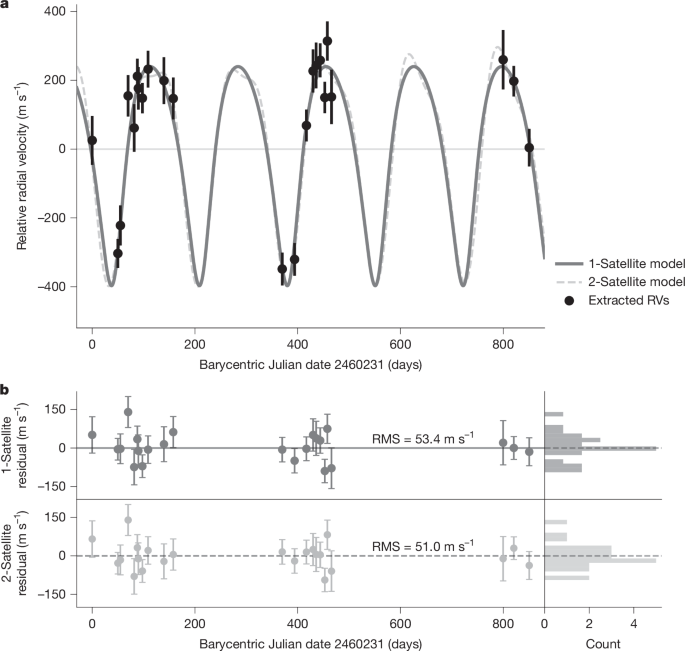
Nature reported evidence for a large exosatellite orbiting CD-35 2722 B, a directly imaged brown dwarf companion to a star. The finding is based on radial velocity measurements from spectra taken with CRIRES+ on the European Southern Observatory’s Very Large Telescope. Brown dwarfs sit between planets and stars in mass, and an object orbiting such a companion can be described as an exosatellite, though whether it should be called an exomoon is not formally settled.
According to the paper, the researchers detected what they interpret as a repeating signal consistent with at least one satellite around the brown dwarf. Their preferred model points to a companion with a minimum mass of about 0.9 times Jupiter’s mass and an orbital period of roughly 170 days. The authors describe this as the first evidence, to their knowledge, that radial velocity analysis has identified satellites around a companion brown dwarf.
The result matters because confirmed exomoons remain elusive despite the discovery of more than 6,000 exoplanets. Previous candidates have been debated, and Nature’s abstract frames this detection as evidence rather than a definitive, uncontroversial exomoon discovery. The same technique has long been central to exoplanet searches, including the first planet found around a Sun-like star.
The paper says the reduced data and analysis code needed to reproduce the work are available through GitHub, with raw observations accessible from the ESO archive. If supported by further observations, the approach could help astronomers extend moon searches to smaller and more planet-like objects as instruments improve.
Loading debate for this article…
Other publishers covering this story
No additional verified coverage is currently clustered with this report.
Related reporting
 Looting Left Damage and Fear on Paradise Street in MarseilleNew York Times World
 Ukraine’s Feeling of Moral Whiplash at the Hands of TrumpNew York Times World
 The Other Bolsonaro Who Could Become Brazil’s Next PresidentNew York Times World
 U.S. Pressures Mexico to Deliver a Security Win Ahead of Midterm ElectionsNew York Times World
 Could Lula Be on the Brink of Defeat in Brazil’s Election?New York Times World
 Why Brazil’s Election Could Come Down to CrimeNew York Times World