
New train service connects Finland and Sweden for first time in decades
What the report says
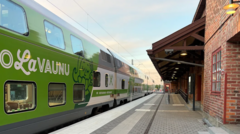
A new passenger rail service has started between Finland and Sweden, restoring a cross-border connection that had not operated for decades. According to BBC World News, the inaugural train left Oulu in northern Finland shortly after 05:00 local time on Monday and crossed the Torne river into Haparanda, Sweden, where it was welcomed by crowds waving both countries’ flags.
The service runs twice a day and takes about 100 minutes between Oulu and Haparanda. While passengers can now travel across the border by train again, those continuing farther south must change trains in Sweden. The BBC said the route had been suspended in the late 1980s or early 1990s because passenger demand was low and because Finland’s track gauge differs from the European standard used in most of the continent.
The return of the line is part of a broader effort in Finland to align more closely with European rail systems. Finland’s wider track width dates back to its period as the Grand Duchy of Finland under Russian rule, and the country is gradually updating infrastructure to match European standards.
The BBC said the new link could help make longer international rail trips easier, including a journey from southern Portugal to northern Finland that is believed to be the longest train route in Europe. It could also support a rail trip between Helsinki and Stockholm in about 24 hours, highlighting renewed interest in cross-border train travel across Europe.
Loading debate for this article…
Other publishers covering this story
No additional verified coverage is currently clustered with this report.
Related reporting
 Israel bans Arab parties from election: Who they are, why it mattersAl Jazeera
 Virat Kohli says he will retire from India cricket after 2027 World CupAl Jazeera
 ‘Super El Niño’ deepens hunger crisis in South Sudan says UNFrance24 Africa
 Special Edition: Our Interview With Mark CarneyNew York Times World
 England vs Spain: UEFA Nations League – Predictions, teams, head-to-headAl Jazeera
 Morocco’s Authenticity and Modernity Party wins parliamentary electionFrance24 Africa