
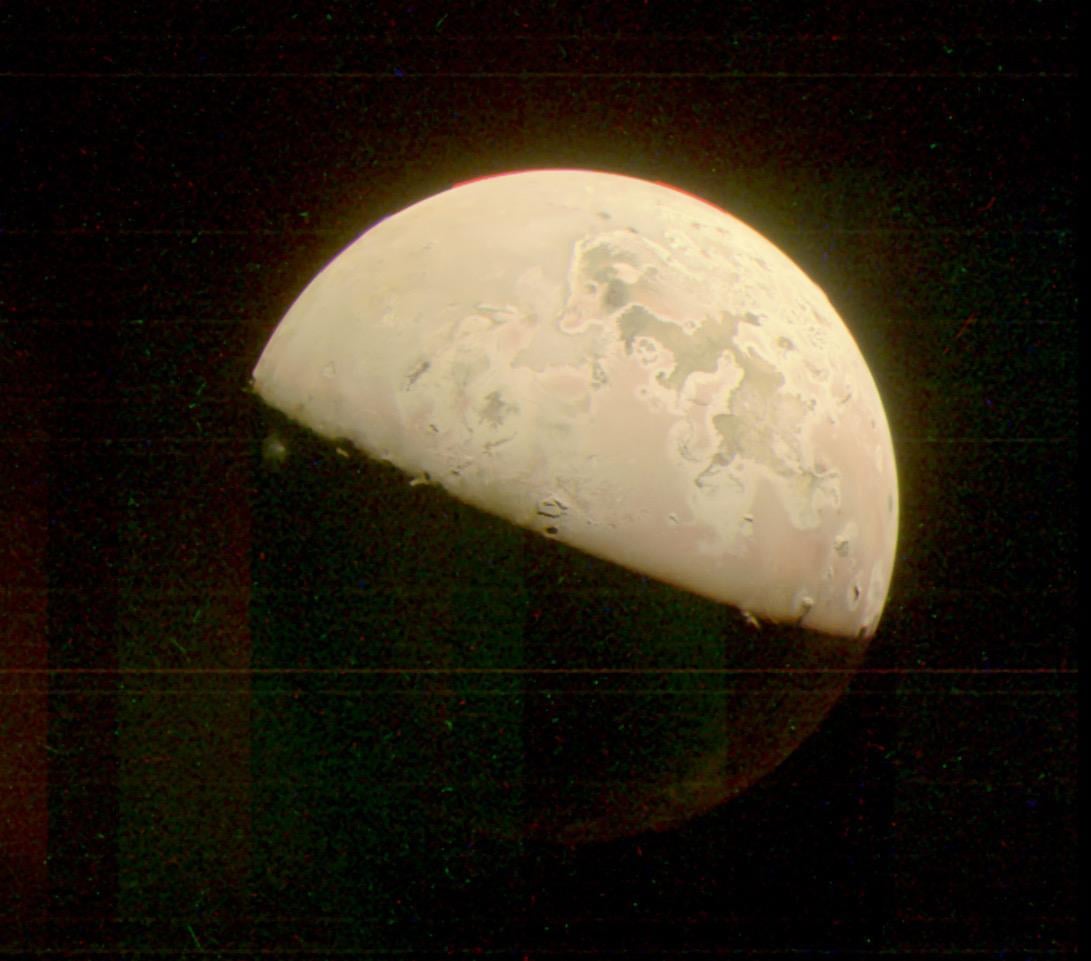
Jupiter's moon Io is the most volcanically active body in the solar system, with hundreds of active volcanoes that can shoot sulphur plumes more than 500 kilometres above its surface — a landscape so extreme that early Voyager scientists initially mistook the p - Space Daily
What the report says
Space Daily reports that Jupiter’s moon Io, once expected to be a cold and inactive satellite, was revealed by NASA’s Voyager 1 flyby in March 1979 to be a world undergoing intense volcanic change. Images taken during and after the encounter showed a brightly colored, crater-poor surface and an unexpected plume rising beyond the moon’s edge — the first active volcano ever directly seen beyond Earth.
According to the report, navigation engineer Linda Morabito noticed the unusual feature while processing a post-flyby optical-navigation image on March 8, 1979, three days after Voyager 1’s closest approach. After checks ruled out another moon or an imaging problem, scientists linked the plume to a dark volcanic region later named Pele. The plume rose roughly 260 to 300 kilometres. Subsequent review of Voyager images found more plumes, and Voyager 2 saw continued activity months later.
The article explains that Io’s volcanism is driven by tidal heating. Its slightly elliptical orbit, maintained by gravitational interactions with Europa and Ganymede, causes Jupiter’s pull on Io to vary. That flexing generates internal heat, melting rock and powering lava flows, lava lakes and explosive plumes. NASA now estimates Io has about 400 volcanoes, though they are not all active at the same time.
Space Daily also notes that Io’s weak gravity and thin atmosphere allow eruptions to tower far above those on Earth. Galileo observations in 2001 detected faint plume material about 500 kilometres high. Later missions, including New Horizons and Juno, have continued to refine understanding of Io, with Juno data challenging the idea of one shallow global magma ocean and instead pointing toward more localized magma sources.
Loading debate for this article…
Other publishers covering this story
No additional verified coverage is currently clustered with this report.
Related reporting
 Seven missing after multi-storey building collapses in Kenya's capitalBBC World News
 Brazil’s Lula and Bolsonaro debate policy proposals before run-offAl Jazeera
 Ethiopian PM’s advisor: Tigrayan forces and others hinder stabilityAl Jazeera
 Just Eat apologises after AI-generated images blunderAl Jazeera
 Ilhan Omar votes as Trump renews attacks amid federal probeAl Jazeera
 Why is Israel launching a new military operation in the occupied West Bank?Al Jazeera