Energy paradox in REM sleep: balancing supply and consumption in brain metabolism - Nature
What the report says
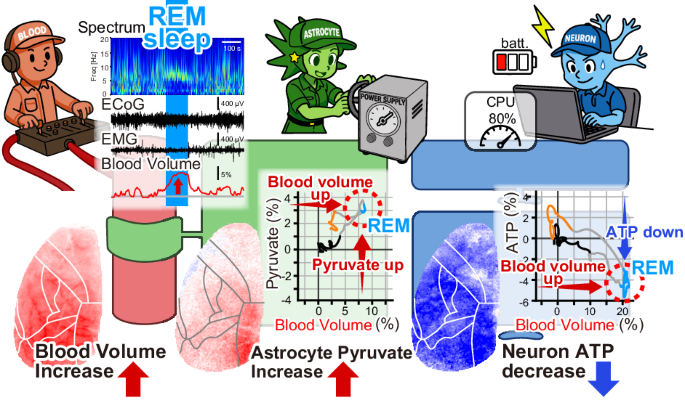
Nature.com reported a mouse study examining how the brain balances energy supply and use across sleep states, with a particular focus on rapid eye movement, or REM, sleep. The researchers used wide-field fluorescence imaging through the intact skull of live mice to track brain blood volume, pyruvate in astrocytes, and ATP in neurons during natural sleep, alongside measures of brain activity.
The study found that metabolic signals were linked to neuronal activity, but that the relationship changed by brain state. During non-REM sleep, theta-band electrocorticogram activity anticipated later changes in blood volume, and the researchers observed fast vascular waves moving from the front toward the back of the cortex. During REM sleep, however, blood volume rose markedly, beginning in the posterior cortex and spreading more slowly across the brain.
The REM finding was described as paradoxical because the apparent increase in energy supply coincided with higher astrocytic pyruvate but a sharp drop in neuronal ATP, the molecule cells use for immediate energy. The authors interpret this as evidence that neurons, astrocytes and blood vessels can become partly dissociated in how they handle supply and consumption, rather than moving in a simple lockstep pattern.
The work matters because sleep is a major brain state, and REM sleep is associated with distinctive patterns of neural activity. The reported results are from mice, so they do not by themselves establish the same dynamics in humans. More broadly, the study adds to research on neurovascular coupling and brain metabolism, suggesting that different sleep stages may use distinct energy-allocation strategies to support computation and maintain cellular function.
Loading debate for this article…
Other publishers covering this story
Related reporting
 Blend your way through smoothies to better health - Daily MonitorDaily Monitor
 NMS Pledges to Address Medicine Shortages, Delivery Delays in WakisoNile Post
Charcoal Grill serves up healthier dining - Daily MonitorDaily Monitor
NMS Pledges to Address Medicine Shortages, Delivery Delays in WakisoNile Post
Charcoal Grill serves up healthier dining - Daily MonitorDaily Monitor
 Blood Test Reveals The Heartbreaking Truth After Millennial Dad Keeps Finding Weird Bruises All Over His Body - Bored PandaBoredpanda.com
 Tick bite, rare bacteria found in dogs at center of Chatham County medical mystery - WRALWRAL.com
 Mum died from aggressive cancer after nine-month wait for test results - au.news.yahoo.comBBC News